
AI is key in new RiverSpring rehab effort

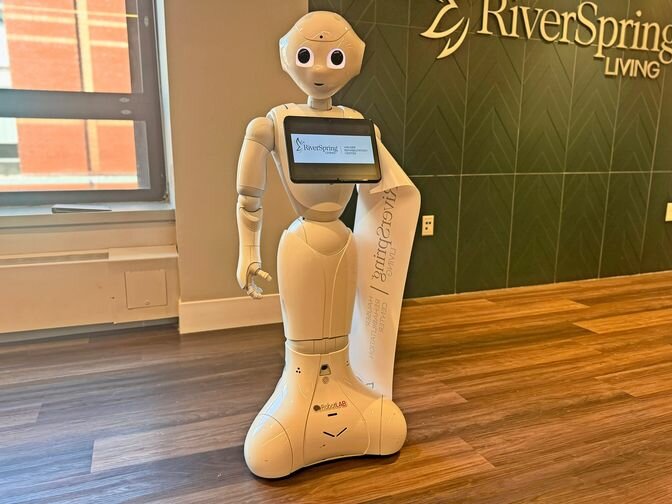


The Hauser Rehabilitation Center at RiverSpring Living is redefining what short-term rehabilitation looks like in the Bronx, introducing an AI-forward, technology-driven model that delivers measurable improvements in recovery outcomes.
The 79-bed unit opened in mid-December and is consolidated on a single floor. The redesign pairs advanced technologies with integrated clinical care in collaboration with NewYork-Presbyterian. NewYork-Presbyterian clinicians provide on-site coverage five days a week, working alongside RiverSpring nurses and physical, occupational and speech therapists. Shared electronic medical records allow hospital and rehab teams to coordinate treatments and reduce duplication of services.
“When we envisioned the Hauser Rehab Center, we wanted uniformity throughout,” said David Siegelman, a physical therapist and RiverSpring’s senior vice president for quality and corporate compliance. “We didn’t want two separate experiences. We wanted to give the same experience to everybody.”
Central to the center’s approach is an emphasis on immersive, interactive therapy that shifts rehabilitation from a passive regimen to an active, engaging process. The facility’s rehabilitation gym features ceiling-mounted body-weight support harness systems, robotic-assisted devices and advanced motion-analysis platforms powered by artificial intelligence.
Among these technologies is the C-Mill, a treadmill-integrated system that projects shapes, targets and pathways onto the walking surface while sensors track gait and foot placement.
“What’s really crucial to understand is that the number one thing we deal with is fear — fear of falling,” Siegelman said. “Once [people] start developing that anxiety, they don’t leave the house. It really could be debilitating.”
The C-Mill’s ceiling-mounted harnesses minimize that fear by ensuring patients cannot hit the floor if they lose their balance. Therapists can reduce a portion of a patient’s body weight during early sessions, easing strain on joints and surgical sites while muscles relearn coordinated motion.
“If I take off 20 percent of body weight, it eases the pain,” Siegelman said. “If they get in motion, the muscles start waking back up.”
Integrated artificial intelligence platforms analyze each step a patient takes, generating detailed data therapists use to tailor individualized treatment plans. Gait speed, stride length and balance metrics feed into virtual environments that resemble game-like landscapes, where patients respond to visual cues by shifting weight, adjusting pace and coordinating movement.
Research has increasingly identified gait speed as a predictive health marker, and Siegelman said the real-time feedback allows clinicians to anticipate challenges before they be come complications.
“There’s a lot out there that gait speed is actually the highest indicator,” he said, noting that slower movement can signal elevated risk of medical events far beyond balance itself.
The immersive elements — simulations that mimic skiing, shifting targets that require dynamic posture control and visual indicators that reward progress — are not merely decorative. Sieglman said they help patients tolerate repetitive motions that are essential to recovery by making therapy feel less like work and more like a challenge.
“Through traditional therapy without body-weight support we were seeing recovery of 60 to 70 percent mobility improvement,” Siegelman said. “Now, we’re seeing over 100 percent improvement in mobility.”
RiverSpring reports that the revamped model has produced tangible outcomes, finding 24 percent fewer hospital readmissions than the national average and a 45 percent lower risk of emergency room visits during a rehabilitation stay. Seventy percent of patients meet or exceed expected recovery targets, compared with 54 percent nationally.
“We send a higher percentage of our patients home than pretty much anybody in the area,” Siegelman said, noting that Medicare ranked RiverSpring in the top 1 percent of nursing homes nationwide for preventing unnecessary rehospitalizations last year. “The vast majority of people who come here want to go home.”
For 65-year-old patient Wilfredo Ortiz, the center’s technology has had a personal impact. Ortiz underwent extensive spinal reconstruction surgery in January following years of chronic pain linked to herniated discs, stenosis and scoliosis — conditions he attributed to decades of physically demanding work as a maintenance and emergency-services employee with the New York City Housing Authority.
After a brief hospital stay, Ortiz was discharged home. In the days that followed his condition worsened, forcing him to return to the emergency room. Hauser was his next stop. The first days of rehabilitation were physically demanding, he said, but the C-Mill system transformed his outlook on therapy — replacing hesitation with confidence and allowing him to focus on rebuilding strength.
“They strap you up with a harness — you can’t fall,” he said. “Using this, I felt safe.”
Ortiz said the digital aspects, from vibrant screens to game-style challenges, make therapy feel less clinical and more engaging. Instead of counting repetitions, he focuses on improving his score or completing a task.
“I look at it as a game, trying to progress, challenging myself to see how much I can do,” he said. “Laughter is very important. You forget about what happened when you’re doing it.”
Ortiz said he has already lost 20 pounds since arriving at Hauser less than a month prior, a goal he set to reduce strain on his back.
“Less fat, less pain on my back,” he said. “And you got good therapists with you that work one on one.”
Lengths of stay vary based on factors like medical complexity and insurance coverage, with some patients remaining for as few as five days; others stay several weeks.
“Every patient is different,” Seagleman said. “Nobody has the same journey.”
Among the other high-tech tools are the Armeo Power robotic exoskeleton for interactive, game-based arm therapy, the VST Balance system, which uses AI and on-screen exercises to turn balance training into engaging challenges, and OmniFlow technology to support early mobility.
Keywords
AI, Riverspring, Hauser Rehabilitation Center,


