
City Council passes more than 50 bills at end-of-year meeting

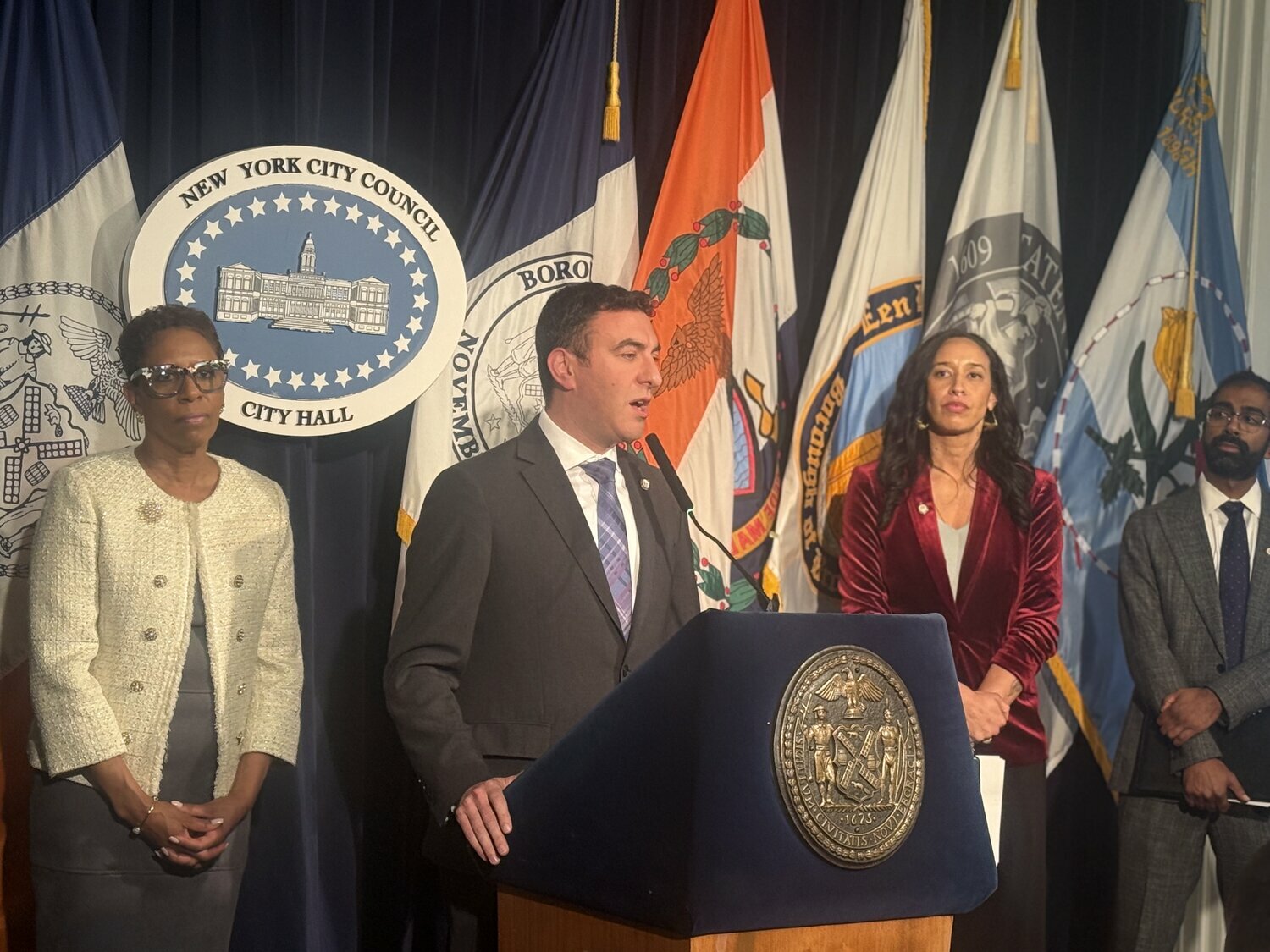


City Council members voted on more than 50 bills at the last meeting of the year, passing several landmark pieces of legislation that span affordable housing, street vendor licensing and construction workers' pay — most of which were introduced by Riverdale area elected officials.
Before any votes were cast, dozens of labor union and advocacy group members gathered outside City Hall on the afternoon of Dec. 18. Some took to the streets, waving flags that bore their logos as chants rang out. Others, including nonprofit Northwest Bronx Community and Clergy Coalition, stood on the building’s steps, surrounded by signs that read “Soy digno” or “I am worthy.”
The coalition has long pushed for two major bills — the Construction Justice Act and the Community Opportunity to Purchase Act — that were ultimately passed later that day, though not without some pushback.
The Community Opportunity to Purchase Act, or COPA, was the most contested bill of the meeting. Sponsored by Brooklyn Council Member Sandy Nurse, COPA gives tenants the first chance to purchase a building if its owner decides to sell. It is meant to keep housing affordable and prevent the displacement of low-income renters, with help from a type of nonprofit called a community land trust.
When COPA reached the chambers, several council members voiced strong opposition, raising concerns the legislation didn’t account for proper funding and would hurt small property owners.
“What happens instead is sales stall, owners walk away, properties deteriorate and the very tenants this bill claims to protect are left living in worse conditions,” said Queens Council Member James Gennaro.
In the last few months, the bill has undergone major changes while in negotiations between Nurse, the Department of Housing Preservation and Development and a coalition of advocacy organizations, with input from real estate stakeholders like the Real Estate Board of New York.
The window for a nonprofit to make an offer tightened from 120 days to 80 days, as did the criteria to qualify for COPA. It now includes only buildings with four or more units, where tenants are at risk from hazardous conditions or of the site becoming unaffordable.
“We are creating a small chance, just a tiny chance, that instead of a building being sold to some company with people and investors from all over the world … we get an opportunity for nonprofits that we trust, that we fund, that we have a relationship with, that we are holding accountable,” Nurse said to the chamber.
The bill passed with 31 votes, five short of the number needed to override the mayor if he vetoes it. Despite this, Northwest Bronx Community and Clergy Coalition Executive Director Sandra Lobo remained optimistic.
“I believe it’s a start,” Lobo told The Press. “It’s a much smaller universe of what’s possible, but it does include buildings that are the most vulnerable … it’s really good grounding for what New York City needs,” adding the coalition wants to engage further with council members who abstained from their vote.
Lobo said the coalition is proud of the success of its other key bill, the Construction Justice Act. Sponsored by Marble Hill’s Council Member Carmen De La Rosa, it passed with 47 votes in its favor.
Some construction workers earn as little as $16 an hour with no benefits, according to De La Rosa. The bill requires they are paid at least $40 an hour in wages and benefits, with no less than $25 of it being wages.
“When routine wage theft is a factor in the reality of so many building affordable housing in New York City, many of them are formerly incarcerated, immigrant workers and daily workers … they struggle to afford basic necessities, as well as their own housing,” De La Rosa said.
Council Member Pierina Sanchez, who represents Kingsbridge Heights, made headway with a package of bills, one of which was aimed at expanding licenses that are available to street food and merchandise vendors.
According to the Immigration Research Project, there are about 23,000 street vendors across the city, but 75 percent of food vendors don’t have permits, and 37 percent of general merchandise vendors don’t have licenses due to caps on the amount the city can give out.
Being licensed makes a big difference in vendors’ profits, and Sanchez’s bill will add 10,500 new general merchandise vending licenses, and 2,200 food vending licenses annually until 2031. It passed with 39 affirmative votes.
“Vendors felt criminalized, brick-and-mortar businesses felt ignored and reform was false,” Sanchez said. “But today, we have a bill that is stronger, clearer and more balanced than what we started with.”
Council Member Eric Dinowitz’s affordable housing bill, which calls for city-funded housing projects to include more 2- and 3-bedroom rental apartments based on family need, also received enough votes to be veto-proof.
“We’re going to stop seeing the flow of our families out of our city,” Dinowitz said. “We’re going to have fewer and fewer families living in shelters, more and more students staying in our public school system, and have a thriving, stable New York City.”
Mayor Eric Adams has until the end of his term on Dec. 31 to vote against any bills passed, at which point it will return to a council that will have eight new members and a new speaker.


