
Bronx bike lanes mark major step in decades-long greenway vision
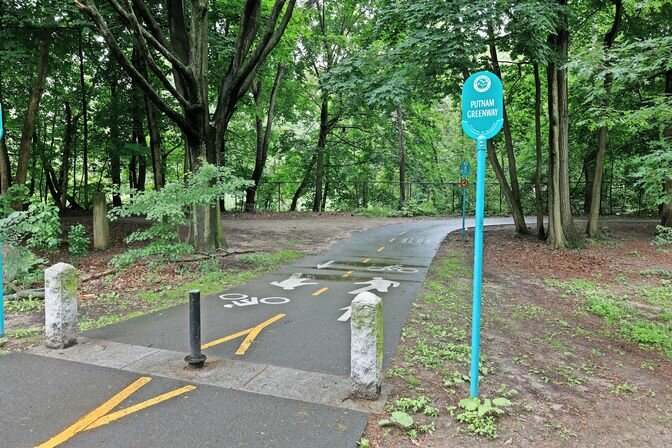


The city department of transportation has started construction on two bike lanes in the northwest Bronx, a step toward a seven-mile, on-street greenway from Van Cortlandt Park to Randall’s Island Park in Manhattan.
For Bronx-based advocacy groups, the DOT’s plan is a major milestone after more than three decades of pushing for a greenway.
Construction is set to finish this year, along with four other sites in the southern Bronx down the Harlem River. Plans for the greenway followed what the DOT said was two years of community outreach to understand ways to better connect Bronxites to their waterfront.
The Van Cortlandt Park South and Bailey Avenue intersection will undergo improvements for pedestrian and cyclist safety, as well as make way for a connection to the Bronx Park and Putnam Trail, which is a greenway path developed along the Putnam Railroad line.
On Bailey Avenue North, DOT will redesign intersections and install pedestrian islands. There will also be a two-way bike path on the west side of Bailey Avenue, from Van Cortlandt Park South and West 225th Street/West Kingsbridge Road.
The community has raised safety concerns for this stretch of Bailey Avenue in the past, as it was the site of two fatalities and nearly 200 injuries between 2020 and 2024, according to the DOT.
Some members of the nonprofit Bronx Council for Environmental Quality have been working since the 90s to have their vision recognized. The council and associated groups, such as the Harlem River Coalition, have called for a continuous greenway along the waterfront — proposed as an extension of the Putnam Trail — as well as resurfacing of Tibbetts Brook and improving water quality in the Harlem River.
Major headway was made last year, when the city department of environmental protection and NYC Parks finalized the purchase of a strip of land adjacent to the Major Deegan Expressway. This three-quarter mile stretch, formerly owned by railroad company CSX Transportation, allows an underground pipe for the brook to continue running.
This means the Putnam Greenway and Tibbetts Brook are joined until just north of 231st Street. At that point, the brook plunges underground until 190th Street, where it will empty into the Harlem River.
The greenway itself ends at 230th Street. According to the DOT, the Tibbetts Brook project is expected to be completed by 2030.
However, Robert Fanuzzi, Bronx Council for Environmental Quality president, said the goal has always been a greenway along the brook. An on-street greenway is an avenue toward improved waterfront access — and more feasible since streets are in the DOT’s jurisdiction. But, the council’s initial objective remains.
“Rather than just asphalt streets along the water, we always thought of the waterfront as being a special place that needs a special landscape around it,” Fanuzzi said, adding the waterfront not only gives opportunity for recreation, but for environmental improvements.
Chauncy Young, a member of the council and the Harlem River Working group, said the DOT’s plan was made with the understanding that, in the future, activist groups would also like to build the greenway on the water. As the on-street greenway will generate civilian traffic, it could lead to greater investments from the city in a waterfront greenway.
The Putnam Greenway as envisioned by the council and other partners, as well as the DOT’s plan for an on-street Harlem River Greenway, still faces connectivity issues due to the Metropolitan Transportation Authority’s Metro-North Railroad, particularly, between West 225th Street and West 230th Street. Activists say, at the moment, there is no active railroad in this stretch. There was also concern the tracks could become a trash-transfer station for Metro-North.
An MTA spokesperson told The Press the tracks are part of a Metro-North yard still actively used for operational support. The tracks are the only switches — mechanisms that let trains move from one track to another — and that the yard cannot function properly without them.
In the DOT’s March 2024 selected routes and draft plan presentation, a Kingsbridge waterfront extension was proposed over the MTA property. This means a bike path would hypothetically run from 230th Street south. A DOT spokesperson said discussions with the MTA continue, though an MTA spokesperson said that there is no possibility of a bike path between West 225th Street and West 230th Street.
Though activists would prefer a more direct route, at this point, a detour is necessary.
Still, some progress on the overall project is underway.
“It’s a huge thing,” Young said. “It’s acknowledging that yes, the community needs a greenway, but it is also a realization that … these things are going to take years from vision to completion.”
The council also made headway in a restoration study for the Harlem River, per a DEP funding agreement announced this month. The U.S. Army Corps of Engineers will lead a study to improve water quality in the Harlem River. Right now, there is a large amount of combined sewage overflows along the river, Young said
“We’re taking it one leg at a time,” Fanuzzi said. As progress continues down the Harlem River, advocates will have to ensure paths are implemented and that they connect with each other. “It’s going to take effort, because we don’t have a waterfront interagency authority,” he said.
“We believe residents in the Bronx and Upper Manhattan deserve access to their waterfront,” Young said. “We are excited this is becoming a possibility for New Yorkers … but we still have an incredible amount of work to do to make this vision a reality.”
Keywords
Bronx bike lanes, Harlem River Greenway, Van Cortlandt Park, Randall’s Island greenway, Tibbetts Brook, Bronx waterfront access, NYC DOT bike project, Bronx environmental groups, Putnam Greenway, Harlem River restoration


