
Building the Bronx, one aspiring architect at a time
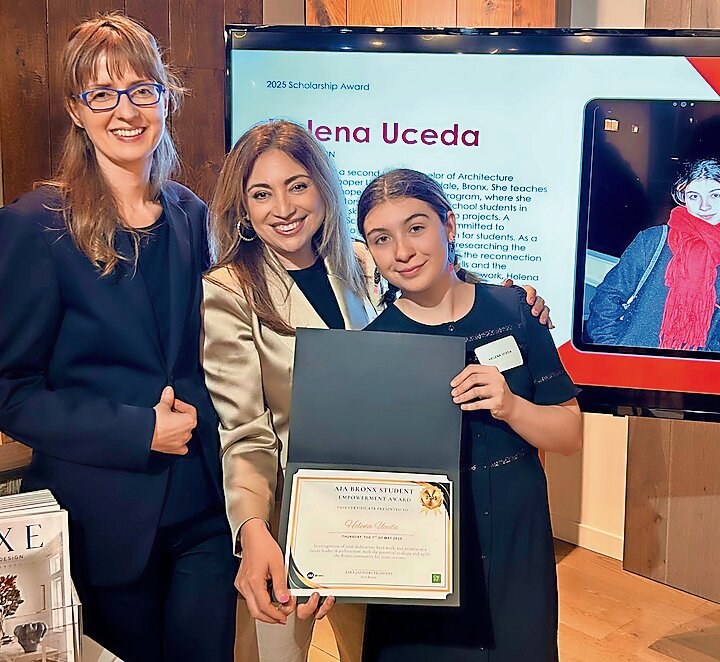
The first time Sara Jazayeri walked into a meeting of the American Institute of Architects’ Bronx chapter, she was the only woman in the room. A dozen men — mostly older, all white — sat around the table.
Years later, the Middle Eastern architect is the chapter’s first female president since its founding in 1945.
Under Jazayeri’s leadership, the institute established itself as a launchpad for young Bronxites, helping to shape the future of the borough through community-rooted design.
At the heart of her mission is a drive to carve new pathways for women in a field long dominated by men. But much of Jazayeri’s philosophy is rooted in a life shaped by upheaval and reinvention.
Born in southern Iran in 1966, a time of sweeping modernization, she recalled a childhood in Ahvaz, a peaceful city brimming with culture near the Iraqi border.
The 1970s brought miniskirts, Western music and a thriving educational landscape. At the time, Iran was run by U.S.-backed Shah Mohammad Reza Pahlavi.
“Iran was very open,” Jazayeri said. “Women going to colleges, becoming doctors, becoming professors.”
Although the middle class flourished, the gap between rich and poor deepened. The Shah pushed for a more secular society, reducing the influence of religious leaders, sidelining Islamic customs and redistributing land once held by the clergy.
Across the nation, a cultural rift between traditional Muslim beliefs and Western influence quickly intensified. Many Iranians rallied behind Islamic leader Ayatollah Ruhollah Khomeini, who sparked the mass uprising that led to the Iranian Revolution in 1978.
Ahvaz was one of the first cities attacked. Bombs leveled neighborhoods. Close friends and family were among the many who perished.
At just 13, Jazayeri was sent alone to Paris for safety. Her father, a physician, remained in Iran to treat neighbors.
Her mother stayed with him.
“I didn’t speak a word of French, besides ‘croissant,’” she said. “In three months, I had enough French to get an apartment and sign up for school. It creates character — you have to do that at that young age.”
After high school, Jazayeri initially followed in her family’s footsteps, working toward a college degree in medicine. She was three years into medical school when she realized the field wasn’t for her.
At her father’s suggestion, who recognized her aptitude for math and creative thinking, she pursued a career in architecture.
At nearly 30, Jazayeri, now married and a mother, moved to the United States. Her family has been part of the Riverdale community for almost 30 years.
Jazayeri worked as an in-house architect for the United Nations on the Upper East Side for three years, later joining two private firms, one in Yonkers and the other in New Jersey.
Then came the 2008 recession.
Like many others, the architecture industry collapsed. Projects were shelved, contracts canceled and layoffs arrived in waves, Jazayeri among them.
With no office or capital, she decided to launch her own firm. She called former colleagues, including some of the city’s top architects and designers, who had also been laid off. Many were mothers like her, struggling to balance their careers and families in a cutthroat profession.
“Only 10 percent of licensed architecture firms in the U.S. are women-owned,” Jazayeri said. “It was scary. I told [the new staff], I don’t have money, I can’t pay you, but work from home on your computer. There’ll be no gap in your career, and, maybe, we’ll get paid eventually.”
In the early days, she hustled outside Trader Joe’s with business cards, striking up conversations with strangers and hoping to find someone planning a renovation or small commercial job.
But by 2020, Jazayeri’s reputation had grown and she was elected president of the American Institute of Architects’ Bronx chapter.
In the same year, she launched the Bronx Design Scholarship. This annual program selects 12 Bronx-based students from six colleges and universities — including Columbia, Pratt, The City College of New York and Parsons — based on financial need, academic strength, and residency.
The goal, she said, is to ensure the borough is revitalized by those who understand it best.
Jazayeri’s initiatives have led students to reimagine neglected Bronx landmarks, including the Kingsbridge Armory and the Bronx Borough Courthouse, not as relics but as active community-driven spaces. Some of those concepts have already helped shape local redevelopment conversations.
Jazayeri also launched a mentorship program for Middle Eastern women in architecture and construction, a demographic she said is often overlooked in conversations about diversity.
“Women in architecture are very plain, very white,” she said. “I wanted to look at it from the angle of a Middle Eastern woman, someone who’s lived through war, through exile, through starting over.”
But for Jazayeri, bringing her borough to life has always been as much about people as it is about buildings. Through her “Where I Work” initiative, she connects Bronx middle schoolers with design professionals across the city.
“Some of these kids have never even been to Manhattan,” she said. “They walk into these firms and see someone who looks like them, leading teams, managing projects. That moment can shift something.”
Like other initiatives the institute offers, “Where I Work” is designed to set participants up for long term success through guidance and mentorship with some of the citiy’s top architects in firms.
Still, she insists, accolades aren’t what drive her.
“I want women to walk into rooms they designed and feel like they’re exactly where they’re meant to be,” she said.
Keywords
Women in architecture, Middle Eastern representation, Community-driven design, Overcoming adversity and exile, Mentorship and education, Bronx revitalization through design, Empowerment through leadership


